
Industrial sectional doors vs. sliding doors – which should you choose for a high-traffic entrance?
Modern logistics centres, production facilities and industrial estates handle hundreds of vehicles every day – ranging from employees’ cars and delivery vans to heavy articulated lorries (TIR). In such locations, the entrance area is a key transport hub. A mistake made during the design of the fencing or the selection of access control systems quickly results in queues in front of the gatehouse, blockages on the access road and the risk of collisions in the manoeuvring area.Investors and main contractors are most often faced with a choice between two solutions: a classic industrial sliding gate and a high-speed folding gate (accordion-style). Both designs have their undeniable advantages, but they are suited to completely different operating conditions.As a Polish manufacturer of fences and gates with many years’ experience, at Rakstal we help customers every day to select solutions tailored to the specific characteristics of their site. Below, we present a detailed comparison of both systems in terms of speed, space and reliability.
Opening hours and logistical efficiency
In areas with traffic volumes of several hundred vehicles a day, every second spent waiting for the barrier to be raised or the gate to open counts.
Sliding gate (with Beninca automatic system)
When designing our industrial sliding doors, we use dedicated automation systems from Beninca – a renowned Italian manufacturer of drives designed for heavy-duty use, tested to withstand a high number of cycles per day.
- Movement characteristics: An industrial sliding gate moves the leaf in a straight line along the fence.
- Opening time: With an entrance width of, for example, 8–10 metres, a standard Beninca industrial operator opens the leaf in approximately 25–40 seconds (depending on the weight of the leaf and the gear ratio used).
- Application: This solution is ideal for situations where traffic flows in waves (e.g. staff changes) or at a moderate frequency throughout the day.
Folding/hinged gate (with DAAB automatic system)
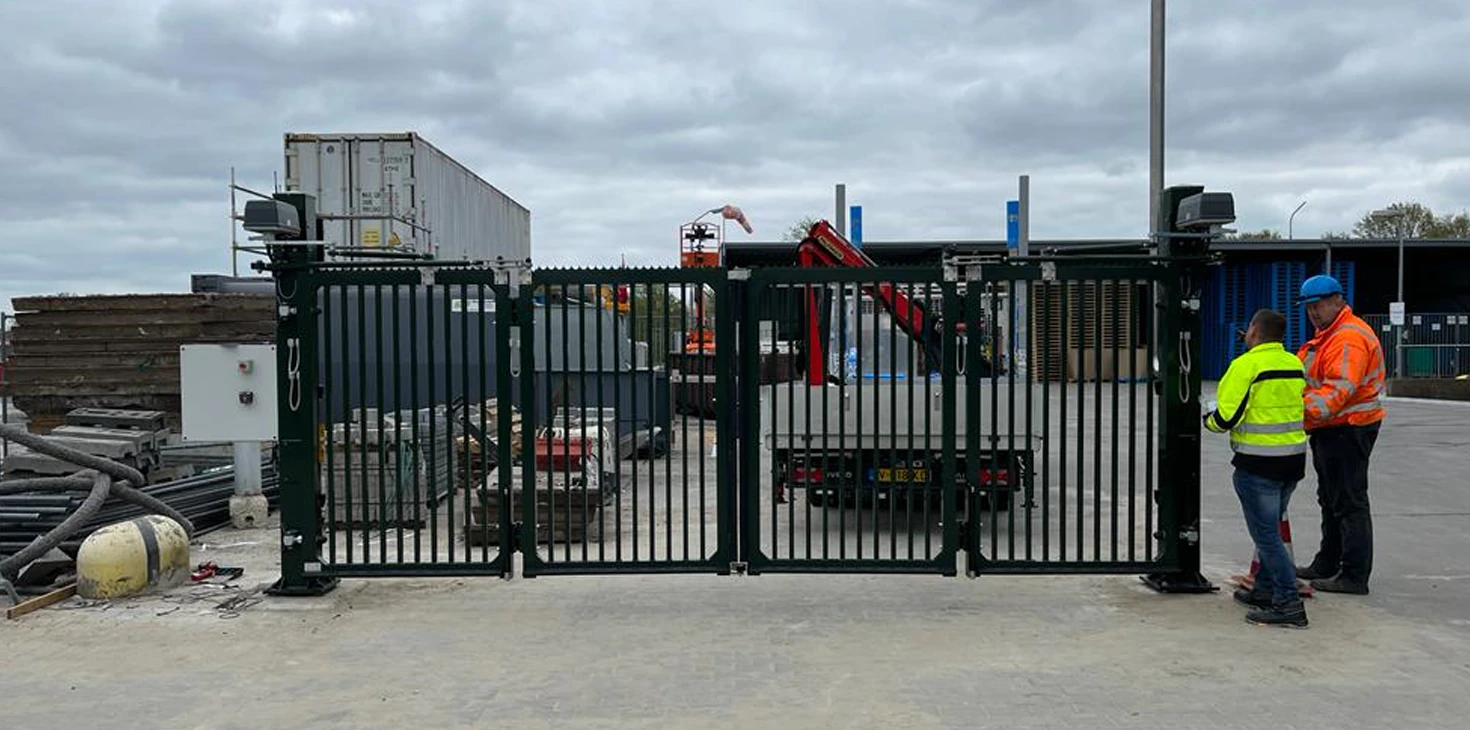
When immediate throughput and the elimination of queues in front of the reception area become crucial, the folding gate comes into its own. As part of our manufacturing process, we produce large-scale Folding and hinged gates for industrial use – including the most demanding projects with an entry span of up to 10 metres, optimised for DAAB’s automation systems (a Swedish specialist in folding gate operators).
- Mode of operation: The gate leaves fold along the posts, much like a folding screen.
- Opening time: Thanks to the use of dedicated arms and DAAB drives, the folding gate can open in just 4–8 seconds!
- Logistical benefit: The lorry driver does not need to come to a complete stop at the gate – the gates open almost seamlessly as soon as the vehicle is identified by the access control system.
Space requirements
The choice of gate is very often determined by the geographical and spatial conditions of the industrial site.
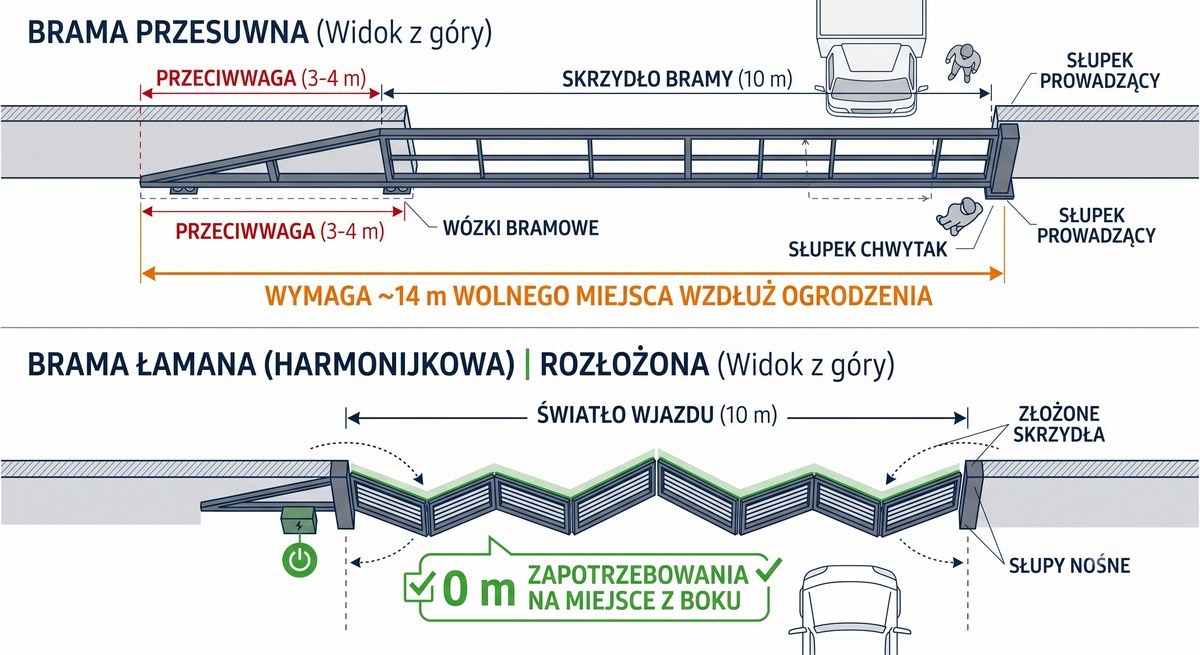
- Self-supporting sliding gate: To cover a 10-metre-wide entrance, a sliding gate requires additional space for the so-called counterweight (usually around 30–40% the length of the entrance opening). This means that along the perimeter fence, we must have at least 13–14 metres of free space, unobstructed by buildings, car parks or internal roads.
- Folding gate: Requires no more than one metre of free space along the fence line. When folded, the gate leaves fit within the clearance of the entrance or just behind the guide posts. This is the only suitable solution for plots with a short fence line, corner entrances and where the site’s infrastructure extends directly up to the gate.
Operational reliability and winter conditions
In industrial environments, the automation system and the gate must operate reliably regardless of the season.
- Difficult terrain and a slope: A sliding gate requires a perfectly level track along the fence. If the ground rises along the fence, it may not be possible to install a sliding gate. A folding gate mounted on posts is completely unaffected by the terrain adjacent to the entrance.
- Winter and snowfall: Both the Rakstal self-supporting sliding gate (mounted on rail trolleys) and the suspended/self-supporting folding gate cope with snow accumulation much better than older rail-based solutions. However, in the event of extreme snow drifts, a folding gate with a higher leaf suspension is less susceptible to mechanical resistance.
Security and integration with access control systems
Both types of gates manufactured by Rakstal are fully compatible with both newly installed and existing industrial gate automation systems. They can be integrated with any access control system:
- Contactless card readers,
- Number plate recognition systems (ANPR/OCR),
- Inductive loops and edge strips (in accordance with standard EN 13241).
It is worth bearing in mind that a high-speed folding gate fitted with DAAB automatic operators further enhances the security of the premises. The time during which the gate remains open is reduced to an absolute minimum. This prevents unauthorised vehicles from entering immediately behind a lorry (known as ‘tailgating’), which is of crucial importance at sites with heightened security measures.
Comparison table – Sliding gate vs. Folding gate
The table below summarises the key functional and spatial parameters of both solutions, helping you to make the right investment decision:
| Parameter / Criterion | Industrial sliding gate (e.g. with a Beninca operator) | Industrial sectional door (e.g. with a DAAB operator) |
| Average opening time (width 8–10 m) | approx. 25–40 seconds | approx. 4–8 seconds (super-fast) |
| Space required to the side of the entrance | Large (entrance light + 30-40% counterweights) | None (the wings fold in at the masts) |
| Recommended traffic volume | Medium / high seasonal | Very high / continuous TIR traffic |
| Protection against unauthorised entry | Standard | Maximum (short opening time) |
| Insensitivity to the surrounding terrain | Low (requires a straight line with no drops) | High (no need to walk along the fence) |
| Sizes available at Rakstal | Up to a dozen or so metres in a single wing | Up to 10 metres of entrance lighting |
| Recommended use | Large plots of land along the fence | Logistics parks, high-density development, heavy goods vehicle traffic |
What should you choose for the entrance to your business?
There is no single, universal solution, but there is a simple decision-making formula:
- Choose an industrial sliding gate with Beninca automation if you have a long stretch of open fencing, traffic at the entrance is moderate, and the cost-effectiveness of the investment is a key factor.
- Choose a DAAB automatic sectional industrial door if your priority is to ensure the immediate, smooth passage of lorries, to avoid congestion at the entrance to the site, or if there is no space to accommodate a traditional door leaf.
At Rakstal, we manufacture gates that are shipped directly from the factory to the building site. We analyse each project in terms of site conditions and the anticipated traffic volume. Contact the Rakstal engineering team – we’ll help you choose the best solution for your project!