
Anti-ram gates for data centres and strategic facilities in practice
Modern perimeter security for high-security facilities has shifted from simply marking out the boundaries of a site towards advanced physical engineering. The dynamic growth of the data centre market in Poland and Europe, combined with the current geopolitical situation and the rise in hybrid threats, presents new challenges for designers, architects and investors.
In the case of critical infrastructure facilities – such as data centres, military installations, airports or defence industry plants – the access control area must not be the weakest link. Ordinary industrial fencing gate It protects against unauthorised entry by pedestrians, but is immediately destroyed in a collision with a heavy vehicle.
How should physical perimeter security be designed in accordance with the PAS 68 and IWA 14-1 anti-ram standards? What should be taken into account when selecting steel structures for the high-security sector?
What are the PAS 68 and IWA 14-1 standards?
These are international standards setting out the criteria and methods for crash tests on physical protective barriers (gates, barriers, bollards). They verify the structure’s ability to stop a vehicle of a specified mass and speed, and measure the distance by which the vehicle or its components have penetrated beyond the line of defence (penetration).
Which facilities require the implementation of anti-ram standards?
Data centres (Tier III/IV), power and fuel hubs, civil and military airports, defence industry facilities, government buildings, NATO military logistics centres and central banking facilities.
Understanding anti-ram standards: PAS 68, IWA 14-1 and ASTM F2656
Three international standards feature most frequently in tender specifications for military projects and commercial high-security facilities:
- BSI PAS 68 – a British standard that pioneered the standardisation of anti-ram barriers.
- ISO IWA 14-1 – an international workshop agreement combining elements of the PAS 68 standard and the American ASTM standard.
- ASTM F2656 / F2656M – an American standard for testing vehicle barriers (frequently used at diplomatic and US Army facilities).
How do you interpret the resistance class marking?
The designation in accordance with IWA 14-1 is as follows: IWA 14-1:2013 Barrier V/7200[N3C]/80/90:0.0
Explanation of the individual parameters:
- V (Vehicle): A test carried out using an actual vehicle (Vehicle Test).
- 7200 [N3C]: Mass of the test vehicle in kg (in this case, a 7.2-tonne lorry).
- 80: Collision speed in km/h.
- 90: Angle of impact (90 degrees = perpendicular impact).
- 0.0: Penetration in metres – a key indicator of how far the load or the vehicle’s engine has penetrated beyond the goal line.
| Standard | Type of test | Key measurement parameters | Main application |
| IWA 14-1 | A real-life crash test (Full-scale crash test) | Vehicle weight, speed, angle, load penetration | Global standard (data centres, airports) |
| PAS 68 | A real-life crash test (Full-scale crash test) | Vehicle weight, speed, angle, frame/cab penetration | United Kingdom, military facilities in Central and Eastern Europe |
| ASTM F2656 | Dynamic test to determine classes M, C and PU | Vehicle category, speed, M30/M50 penetration level | Military bases, NATO facilities, embassies |
The anatomy of a high-security gate in manufacturing practice
As a manufacturer specialising in anti-terrorism gates as well as advanced access control systems for airports and military facilities; at Rakstal, we know that the resilience of structures subject to heightened security requirements rests on three pillars: dead weight, frame stiffening and anti-climb protection.
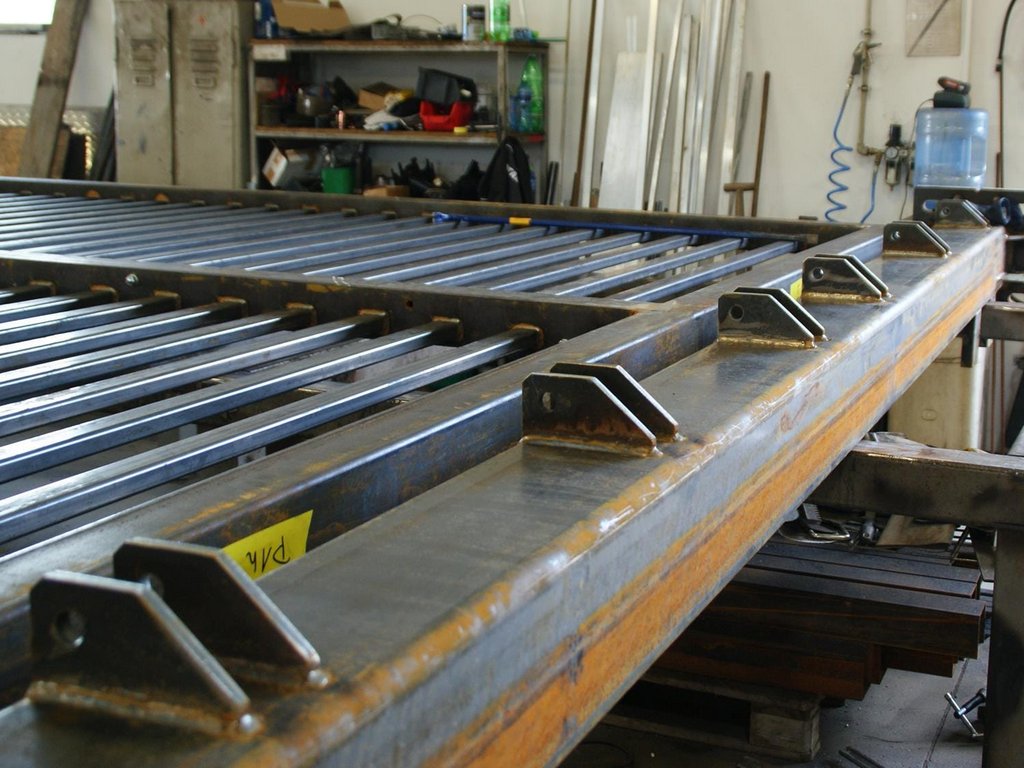
Photo 1: The robust steel frame of a large-scale door during the manufacturing process at the Rakstal factory. The thick profile sections and solid mounting brackets are clearly visible.
Steel reinforcements and armoured sections
Ordinary thin-walled sections bend under even minimal mechanical stress. In structures designed for critical infrastructure, the following are used:
- Thick-walled structural steel sections with a high yield strength.
- Internal truss bracing and steel connecting lugs at the joints, which transfer the impact force directly to the guide posts.
- A spindle and bolt locks with enhanced shear resistance.
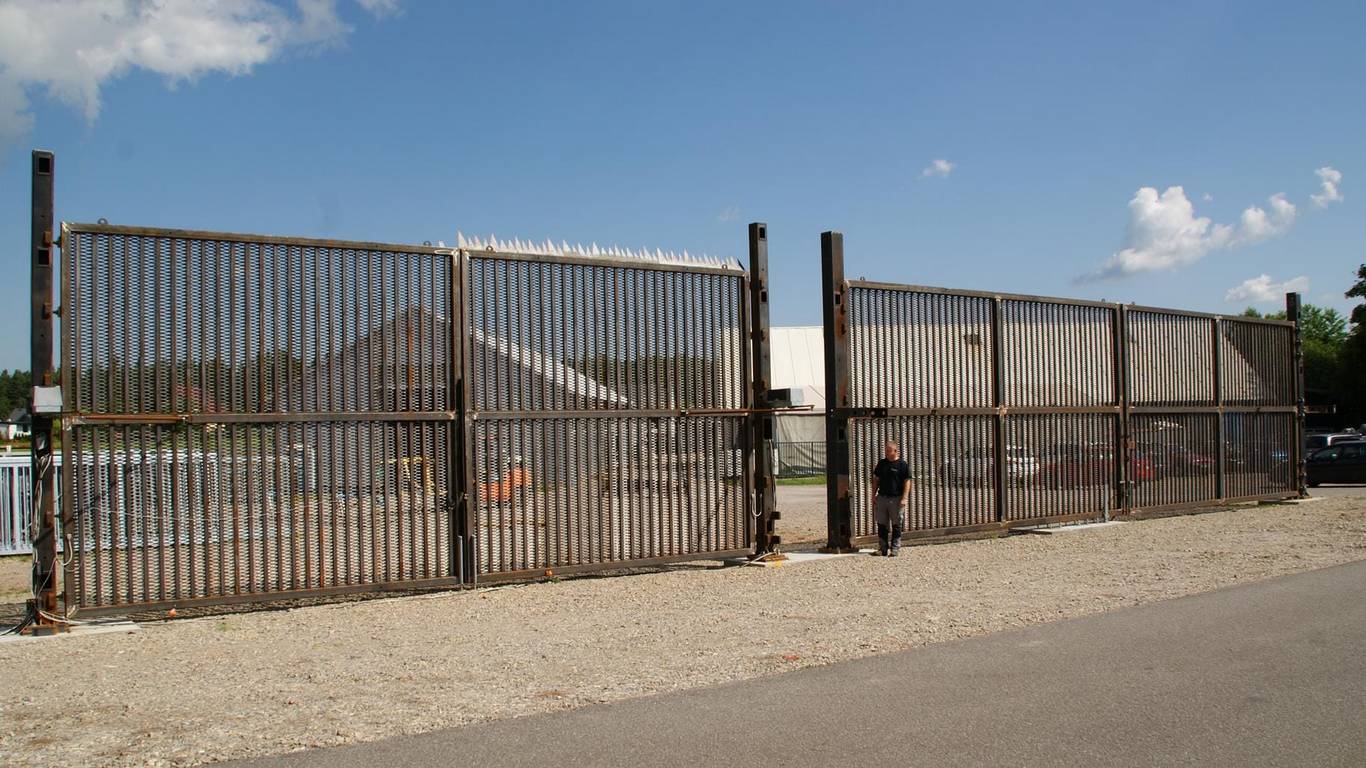
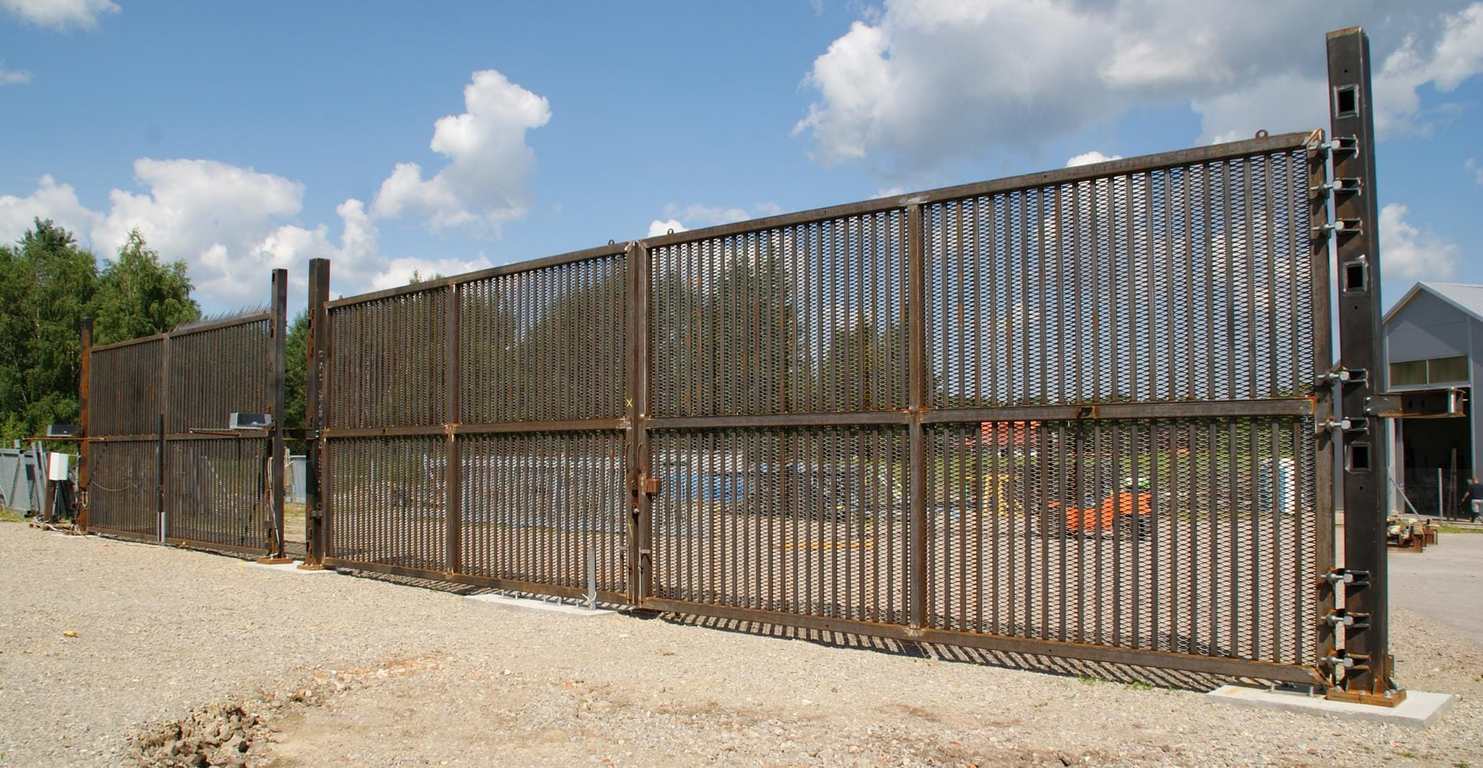
Fig. 2: The scale of a large perimeter gate over 3.5 metres high. The weight of the gate leaf alone, combined with its solid infill, creates a physical barrier that is difficult to breach.
Anti-climb devices (Anti-Climb)
Protection against vehicle ramming must go hand in hand with preventing pedestrians from gaining unauthorised access. Industrial gates for strategic facilities are fitted with:
- Welded toothed ridges: Sharp, laser-cut steel ridges along the upper edge of the frame, eliminating the possibility of gripping the edge with the hand.
- Barriers that are difficult to breach: The use of a dense palisade made of hollow-section profiles or expanded metal mesh, which prevents a foot from being inserted and makes it impossible to cut through with hand shears.
- Barbed wire (Concertina): Integrated straight or „V”-shaped arms designed for the installation of razor wire barriers.

Fig. 3: Close-up of the upper edge of the Rakstal gate leaf – an integrated steel toothed comb with sharp tips and a dense mesh infill providing an effective anti-climb barrier.
Guidelines for airport and strategic infrastructure
In the case of airports (AIRSIDE / LANDSIDE zones), the guidelines require that full visibility of the entry zone be ensured whilst maintaining the continuity of perimeter security.
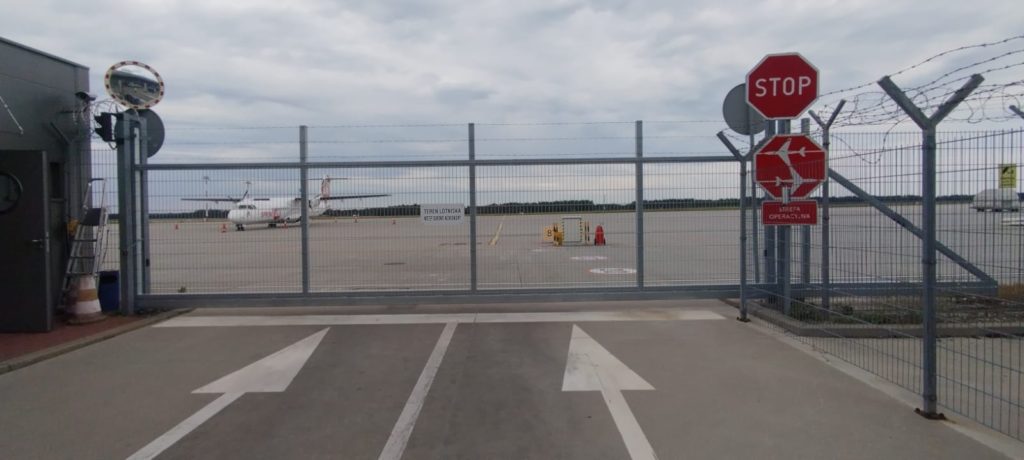
Photo 4: A Rakstal industrial sliding gate installed at the entrance to the airport’s operational area. It is fitted with booms with barbed wire, warning signs and traffic safety systems.
Circuit integration
The gate itself, even if it holds PAS 68 / IWA 14-1 certification, operates as part of a wider site security ecosystem (Integrated Security). To ensure comprehensive protection, the design should take into account:
- High-speed drives: Industrial drives designed for continuous operation (100% duty cycle). The shorter the time taken for the gate to open and close, the lower the risk of an unauthorised vehicle entering directly behind an authorised vehicle (known as ‘tailgating’).
- Integration with automation systems for gates subject to high security standards: Connection to induction loops, underbody scanners (UVSS), long-range readers (RFID/OCR) and the central control logic of the SMS (Security Management System).
- Visual warning markings: The use of high-contrast paint finishes (e.g. warning stripes in RAL 3020 / RAL 9016), traffic lights and infrared light barriers.
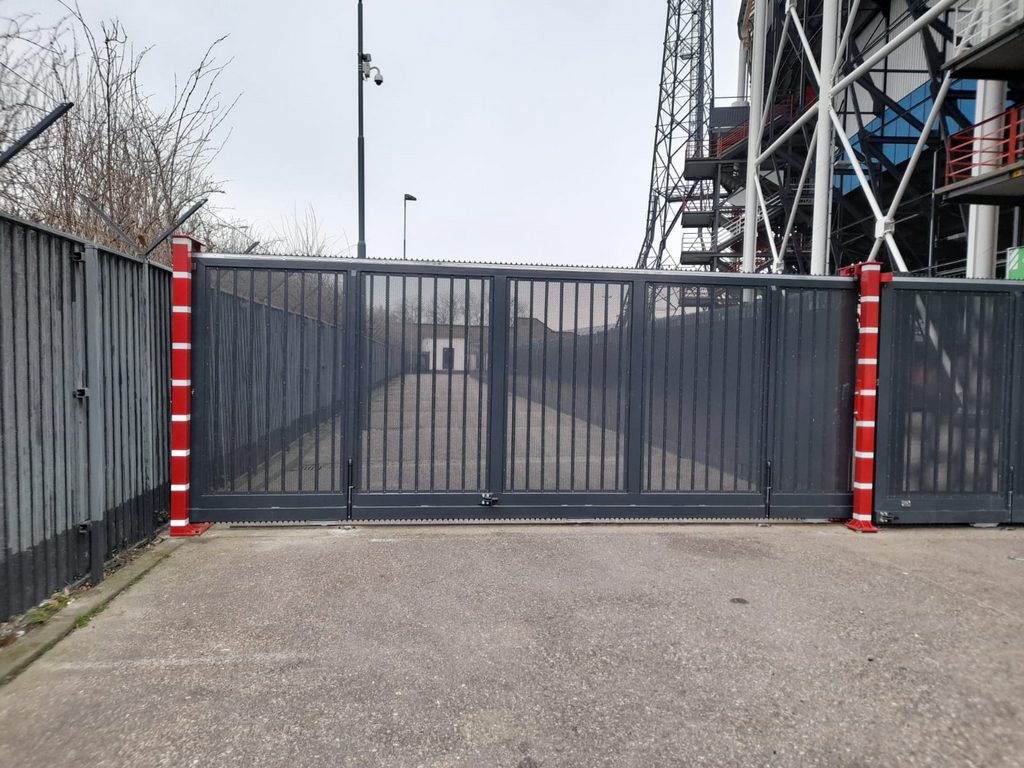
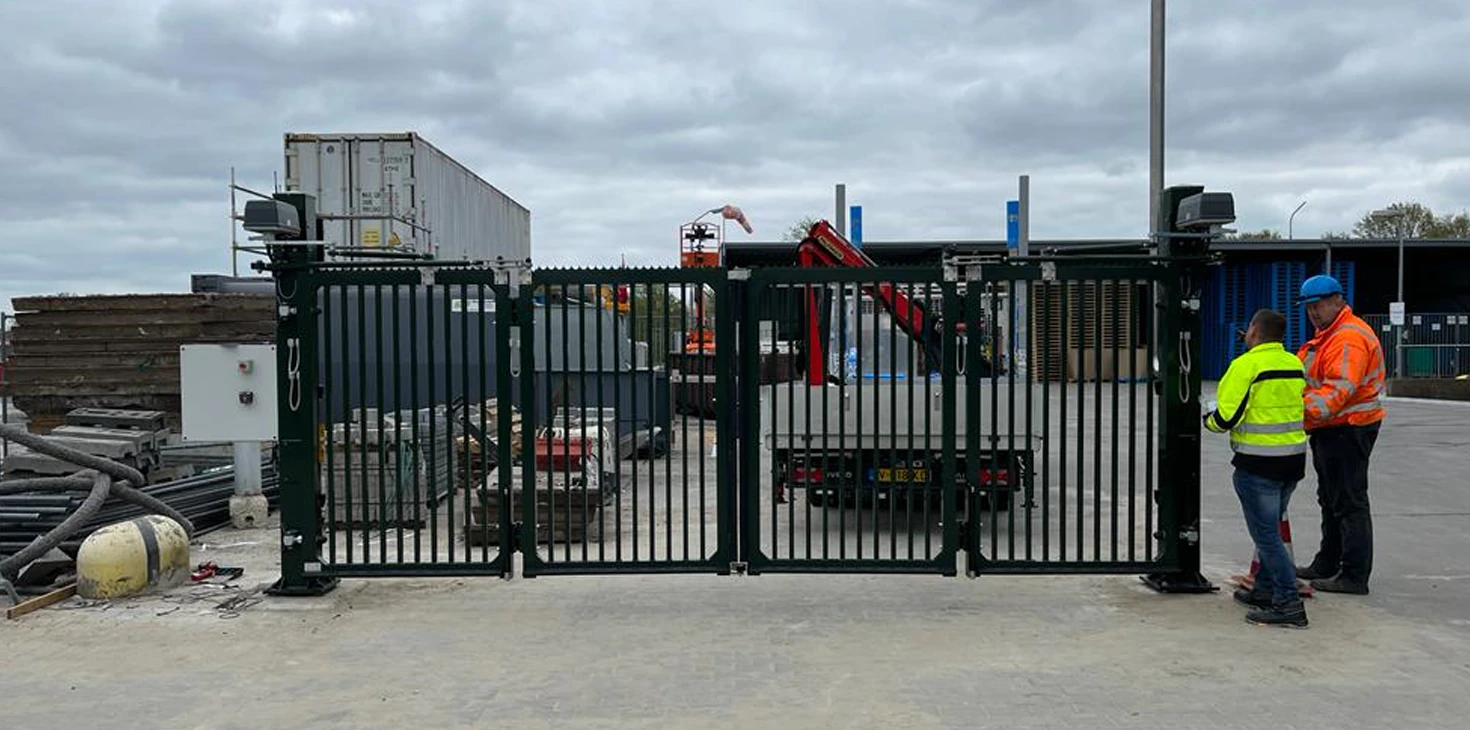
Fig. 5: A sliding gate with lighting and high-visibility paint on the end posts, designed for integration with an access control system at a commercial site with enhanced security requirements.
The most common design errors in high-security fencing
When reviewing detailed design and construction drawings for critical infrastructure facilities, Rakstal’s engineers most frequently identify three key errors:
- Underestimation of foundation depths – a door with a high impact resistance rating acts as a lever. At the moment of collision, the vehicle’s enormous kinetic energy is transferred to the posts and guide rollers. If the foundation is too shallow or made of concrete of an insufficient strength class (e.g. below C25/30), the entire structure, including the concrete block, will be torn out of the ground.
- Physical inconsistency in the circuit (break in the continuity of protection) – a common mistake is to design armoured anti-terrorism gates ramp barriers combined with a lightweight panel fence without a concrete foundation. The strength of the protected perimeter is determined by that of its weakest component.
- Lack of an evacuation procedure and emergency power supply (Fail-Safe vs. Fail-Secure) – in facilities such as data centres, a loss of external power supply must not cause the gate to open automatically (Fail-Safe mode is a critical fault in this case). Access control systems must be equipped with an uninterruptible power supply (UPS) and dedicated manual override mechanisms enabling access control by authorised personnel.
The design of fences and gates for strategic facilities – from data centres to defence sites and airports – requires a move away from standard catalogues of civilian fencing. The key to success is early technical consultation with a manufacturer capable of producing bespoke, thick-walled steel structures.
At Rakstal, we have the production facilities and expertise to carry out even the most demanding industrial and specialised door projects.
Please contact Rakstal’s Technical Department – We will analyse the specifications of your project, help you select the structural strength parameters and prepare a bespoke quote for your project.